
“Sunscreen is the closest thing we have to a fountain of youth — and SPF 50++ is its most powerful form.”
Of all the products in your skincare routine, sunscreen is the only one with decades of clinical evidence proving it slows skin aging, prevents cancer, and protects your skin’s long-term health. And yet, it remains the most skipped step — especially on cloudy days, indoors, or during winter months when UV rays are still very much present.
SPF 50++ raises the bar further. It doesn’t just protect — it shields, prevents, and preserves in ways that lower SPF ratings simply cannot match. Whether you’re at the beach, commuting to work, or sitting near a window, here’s why SPF 50++ deserves a permanent place in your daily ritual.
Know Your Enemy: UV Rays
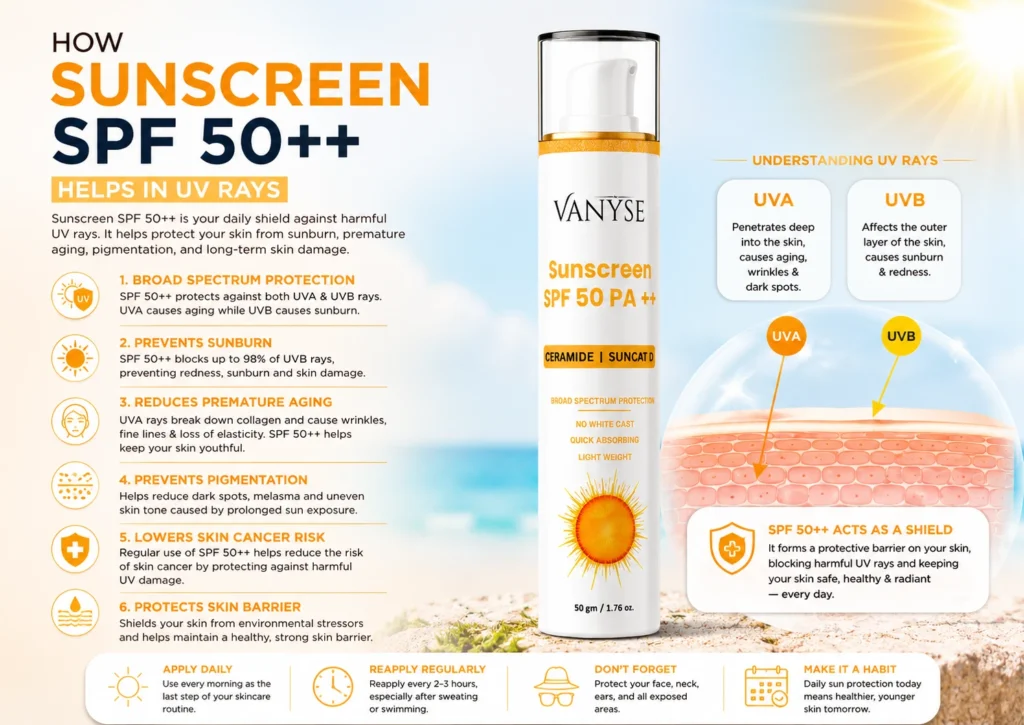
Not all UV radiation is the same. The sun emits multiple types of ultraviolet rays, and each one damages your skin differently. Understanding them is the first step to understanding why SPF 50++ matters.
Wavelength 320–400nm
UVA Rays
Penetrate deep into the dermis. Responsible for premature aging, wrinkles, and dark spots. Present year-round, all day — even through glass and clouds.
Wavelength 280–320nm
UVB Rays
Damage the skin’s surface. Cause sunburn, redness, and are the primary driver of skin cancer. Intensity varies by season, altitude, and time of day.
Wavelength 100–280nm
UVC Rays
The most dangerous but mostly absorbed by the ozone layer. Rarely reaches Earth’s surface — but as the ozone depletes, this is changing.
What Does SPF 50++ Actually Mean?
SPF — Sun Protection Factor — measures how much UVB radiation a sunscreen filters out relative to bare skin. The “++” notation signals that the product also offers high-level UVA protection, making it a true broad-spectrum shield.
8 Ways SPF 50++ Protects Your Skin
Prevents Sunburn
By blocking 98% of UVB rays, SPF 50++ virtually eliminates the risk of sunburn — even during prolonged outdoor exposure on bright days.
Anti-Aging Defense
Up to 90% of visible skin aging — wrinkles, sagging, fine lines — is caused by UV exposure. Daily SPF 50++ is the most effective anti-aging product available.
Skin Cancer Prevention
Regular broad-spectrum sunscreen use significantly reduces the risk of melanoma, the deadliest form of skin cancer, and other UV-induced malignancies.
Hyperpigmentation Control
UV rays trigger excess melanin production, causing dark spots and uneven tone. SPF 50++ prevents new pigmentation and stops existing spots from darkening.
Collagen Preservation
UVA rays break down collagen and elastin in the dermis. SPF 50++ shields these proteins, keeping skin firm, plump, and structurally intact for longer.
Reduces Inflammation
UV-induced inflammation drives redness, rosacea flares, and post-acne marks. SPF 50++ prevents the inflammatory cascade at the source.
Even Skin Texture
By preventing sun damage, SPF 50++ allows the skin’s natural renewal cycle to work unimpeded — resulting in smoother, more refined texture over time.
Protects All Skin Tones
Darker skin tones have more melanin but are not immune to UV damage or skin cancer. SPF 50++ is equally essential across every complexion.
Dermatology Research
“People who used broad-spectrum sunscreen daily showed no detectable increase in skin aging over a 4.5-year period — compared to significant aging in the discretionary-use group.”
— Annals of Internal Medicine
How to Apply It Correctly
Even the best sunscreen underperforms when applied incorrectly. Most people use only 25–50% of the recommended amount — which can cut protection by more than half. Here’s how to get the full benefit of SPF 50++.
- Apply 20–30 minutes before sun exposureSunscreen needs time to bind to the skin. Apply before you step outside — not after you arrive.
- Use the two-finger rule for face Squeeze sunscreen along two fingers — that’s roughly 1/4 teaspoon, the amount needed for adequate face and neck coverage.
- Cover all exposed areas Ears, back of the neck, tops of hands, and lips are the most commonly missed spots — and among the most vulnerable.
- Reapply every 2 hours No sunscreen lasts all day. Sweat, water, and sebum degrade the film. Set an alarm if you’re outdoors for extended periods.
- Use year-round, not just summer UVA rays are constant through all seasons and weather. Winter sun at altitude can be just as damaging as a July beach day.
- Layer it last in your skincare routine Apply after moisturizer but before makeup. Mixing sunscreen with other products dilutes its SPF and breaks the protective film.